Leavening
On breadmaking and resurrection

Bread, says my husband, is magic. Sadly, he never took to cooking or baking, so he thinks all of it is magic. But about bread, he has a point. Midge Goldberg makes that point in a recent iteration of The Sonneteer, and she’s talking about sourdough, where problems of technique and control are even more evident than with ordinary yeast dough. Yeast dough doesn’t “just work” as easy recipes do; you have to get a literal feel for it; you have know how it should act and feel under your hands. You have to become an adept. An association with things enchanted extends to all bread: beginning with the unleavened kind, which links us to Passover and the eucharist, extending to beautiful braids of challah and the long, white Italian loaves revered in my childhood. Is the yeasty stuff less holy? Not in my estimation. Yeast is a living thing, so mysterious that only within my lifetime have we figured out how to classity it. And I celebrate it in this poem, first published in America and in the book The O in the Air.
Saccharomyces cerevisiae, or A Little Levity About Leaven
Because, in its stubby brown-glass jar
or its battered, three-personed foil packet,
it gets entombed in the chaos of cartons
appearing at last, as though resurrected,
Because the lump in which it lies hidden
is formless and potent as creation’s clay,
Because I sink my hands in its history
and come up with levamen—
“solace” or “consolation,”
Because it’s consoling to smack it down—
pummel it, grinning like a Halloween demon—
and find I never defeat it,
Because its down-and-up-again persistence
is like a congregation’s kneeling and rising
(Levate, in the Latin of old rubrics),
Because, at some point in the fifty years
since I learned to file its fungal names
among the tangled roots of the Plantae,
they bloomed, those names, as a kingdom of their own,
And because this makes me smile, recalling
that leaven’s Your own little joke about the Kingdom,
Be praised, O Lord, for this bit of mystery,
which lifts, which lightens.
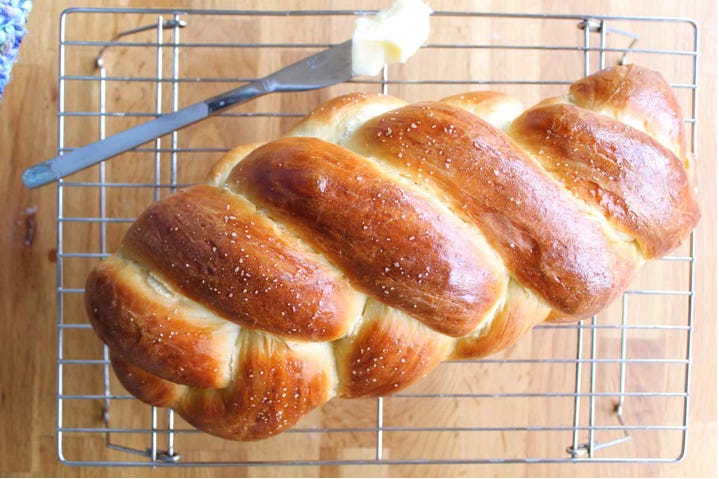
(Photo credit: Story of a Kitchen)
Etymology is also rather magical.
Susan McLean
A good poem Maryann, as honest as its subject.