Stuff: a meditation
A sonnet not-quite-crown about the problem of things that pile up

It’s been move-out, move-in season here recently, and the phenomenon of piled-up stuff in yards and alleys prompted me to think again about this sonnet sequence from my 2023 book, The O in the Air. The word “mess” describes so much in modern life . . .
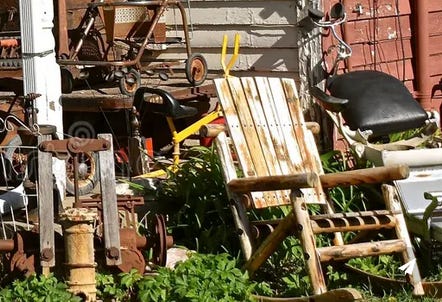
Hoarder
The mess it makes, dear God: mountains of crap
spewed on the lawn, obscenely disarrayed.
Whatever sort of order her mind made
of this—crateloads of paper, whole and scrap;
torn couches (drunkenly tipped, upholstery damp
in the spring drizzle); bolts of stained brocade—
is violated. Dumped like a corpse. The date
came, and the truck, and the dumpster, dollies, and ramp
of the cleanout crew. Her cut-rate obit, bare,
boxed in the local paper’s tidy square,
painted a straight-edged life. It wasn’t true.
And now what’s spilling from the garbage bins
lays bare before the world our local sins:
She was a hoarder, and we never knew.
We never knew. We knew she got her mail
and scuffed outdoors in slippers for the flyers
left on the walk, mincing, as though by braille.
We didn’t like to snoop. Should we be pryers
into her fenced-off life? It was enough
to see that someone shoveled, someone mowed.
And in subzero weather, the white puff
of a working furnace was a sort of code
for All-is-well-enough-leave-it-alone.
The porch light still fell feebly in gold pools
onto the graying snow. We had our own
troubles: rezoning, trash collection, schools,
taxes that burgeoned, dandelions that bloomed.
Dailiness ate us up. We were consumed.
We were consumed? I keep on saying we.
Let’s talk about my own consuming passions,
the matter I’ve amassed for sixty years,
I and my spouse. At least our progeny
have flown, trailing their jettisoned possessions,
yet overnight we crammed space that was theirs
with things: books that seemed vital in the moment;
music, its living soul encased in vinyl.
What happened to the frugal hippie bride
I thought I was? What if it had to go—
everything, by some deadline, settled, final?
Fervent recycling wouldn’t stem the tide.
The angel might as well begin recording
the worst: I am a hoarder. This is hoarding.
Yeah, hoarding. But the stuff is not the worst.
The worst is what the body can’t unload.
Memory’s bad enough when it’s the goad
you kick against to trash the things it cursed.
(The dinnerware that graced the very worst
meals of your younger life, china by Spode,
glass by Lalique?) But memory can explode
in pain unpurchased, pain you were coerced
into the bearing of. (The fractured marriage
that fouled your mother’s years down to her death,
its sadness handed down.) Traditio,
that quake you didn’t feel, still leaves its wreckage.
Yours now, it keeps its chokehold on your breath.
Worse than the stuff you own is the stuff you know.
The family stuff I know, down in my bones.
The world’s junk hangs around in the tainted air,
a vague particulate matter, but it’s there.
Sometimes my reading stirs it, and it moans
like Dickens’ floating Christmas spirits. Groans
rise from the past, translated by the best
in prose and verse, and humankind’s unrest
comes wailing from the ancient combat zones.
Or the rich years postwar, whose lead exhaust
coughs on. Or the misogynistic blather
of every body-loathing Latin Father.
Or the long foghorn of the Holocaust—
It deepens, Larkin says, like a coastal shelf,
this mess. Beyond Marie Kondo herself,
this mess, and inescapable in life.
To get past stuff, it seems you have to die.
The real life-changing magic, Dante says,
comes when you take the step beyond belief
and into matter-less eternity
where the unblinding Brightness purifies.
How long a flensing does it take a soul
twisted by decades clenched around its hoard
(would Dante classify that pain as Greed?)
to shake its brittle shell off and uncoil?
Pain cleanses—that’s the theory—and you’re spared.
Look up; the Light is everything you need.
This is the theory. And I’ll hope for this
for my poor neighbor, may she rest in peace—
In peace? And then the last line of the Creed—
the resurrection of the body and
life everlasting—snaps me back. I need
to get things clearer. Where we finally stand
is in our bodies? Bodies made of stuff?
It’s difficult to hear this as good news.
The fear that guts the concept of enough,
the gore that everlastingly ensues,
the epics of it, branded on the brain—
How bodies slough the awful heft of hoarding
is something theologians don’t explain
but promise, though for now we’re stuck here, Lord:
these bodies, and this stuff, and this distress.
The mess, dear God. Forgive us for the mess.
(first published in Raintown Review)
Magnificent poem about which I think often. We were in that issue together. The last, as it turned out.